11
Japan's Political Economy After Golden Week 2026
Japan entered the post-Golden Week 2026 period with a rare sense of confidence. The Nikkei 225 breaking its all-time high on the first working day was a strong signal of market faith in the direction of the 'Land of the Rising Sun'.
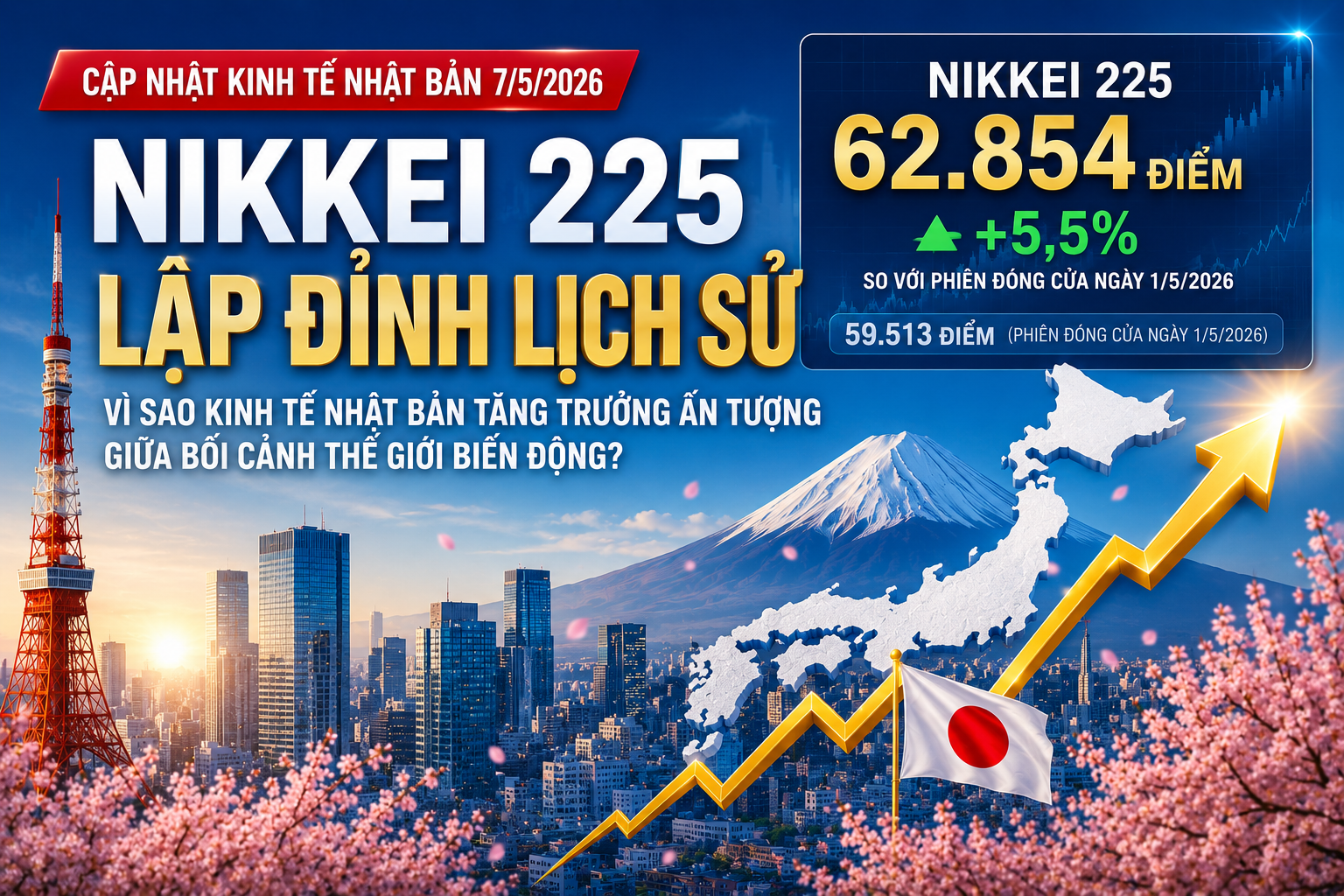
May 7, 2026 — First working day after Golden Week
1. Geopolitical backdrop: From energy crisis to peace signals
The period from late April to early May 2026 placed significant pressure on Japan's energy security. The conflict between the United States and Iran pushed Brent crude oil prices to $126 per barrel — the highest level since 2022 — amid fears of a prolonged blockade of the Strait of Hormuz. For a country like Japan, which relies on the Middle East for more than 90% of its crude oil imports, this posed a direct threat to macroeconomic stability.
However, on 7 May, markets reopened with a turning point: President Trump declared that military action would end if Tehran accepted a deal, as both sides moved closer to a peace memorandum of understanding (MOU). Brent crude prices cooled to around $101–$104 per barrel, allowing Japanese businesses to reduce input costs and significantly improving market sentiment.
Macroeconomic indicators forecast for fiscal year 2026:
Sources: BoJ Outlook April 2026, Vanguard Japan Outlook, Fitch Ratings
2. Stock market: Nikkei 225 breaks historic high
Trading session on 7 May 2026
In the first trading session after the Golden Week holiday, the Nikkei 225 surged more than 5.5% from its close on 1 May (59,513 points), hitting an intraday high of 62,854 points — a 52-week record and the first time it crossed the psychological threshold of 62,000 points. Trading was active, with strong net buying by foreign investors.
Two main drivers fuelled this rally:
- Hopes for US-Iran peace, reducing geopolitical risk premiums across Asian financial assets.
- A strong rally in US technology/AI stocks during Japan's holiday period — the S&P 500 hit a record 7,365 points, and the Nasdaq Composite surpassed 25,838 points — creating a spillover effect on Tokyo as soon as markets opened.
Earlier, Nikkei futures on the CME had signalled a sharp rise, reaching 60,620 yen on 6 May, up about 1,200 yen from the previous session — reflecting geopolitical developments and accumulated earnings results over the holiday period.
Leading stocks
The main momentum came from semiconductors, information technology and basic materials:
*Recorded in the session on 1 May before the holiday
This recovery appears more sustainable than previous rallies, which were dependent on a weak yen. Companies are increasingly focusing on raising dividends and buying back shares to improve ROE — a corporate governance reform trend that is winning favour with foreign investors.
Important note: The year-end price targets of 54,000–55,500 points set by BofA and UBS at the start of 2026 (when the Nikkei was still in the 38,000–40,000 range) have been far exceeded by reality. Major investment banks are currently in the process of updating their targets. Some optimistic scenarios now place the year-end level at 65,000–67,000 points, provided energy prices remain stable and the AI-driven rally continues.
3. The Yen and BoJ Monetary Policy
Exchange rate developments on 7 May 2026
As of today's trading session, USD/JPY is fluctuating around 156.76, with a daily range of 155.73 to 157.25. This represents a stronger yen compared to its recent peak (above 157.50), partly due to foreign exchange intervention by the Japanese government. Short-term technical indicators are in "Strong Sell" territory, meaning buying pressure on the yen is prevailing.
The yen surged to its highest level in more than two months, fuelling speculation that Tokyo may continue to intervene in the foreign exchange market.
Three mechanisms have driven the yen's weakness since the start of the year:
- Carry Trade: Japan's interest rate remains at 0.75% while other economies are significantly higher, leading the yen to continue being used as a funding currency.
- Trade Deficit: Rising energy import costs create natural selling pressure on the yen to pay for fuel bills.
- Risk Sentiment: The yen's status as a safe haven has eroded during the period of Iran tensions due to concerns about the economic shock from a potential cut-off in oil supplies.
BoJ interest rate roadmap
The Bank of Japan (BoJ), under Governor Kazuo Ueda, is normalising monetary policy cautiously. The BoJ has just raised its inflation forecast for fiscal 2026 to 2.8% (from 1.9%) while lowering its growth forecast to 0.5%, creating pressure for an earlier-than-expected interest rate hike.
Forecasts from Vanguard and Nomura suggest the policy rate will reach 1.00% by July and head towards 1.25% by the end of the year. This process aims to control imported inflation, create policy room, and support household purchasing power.
The challenge ahead: the yield on 10-year Japanese government bonds (JGBs) has risen to around 2.50% — its highest level in two decades — significantly increasing the cost of servicing Japan's public debt. If oil prices stabilise following an Iran peace agreement, inflationary pressures will ease, allowing the BoJ a more gradual path for rate hikes.
4. Political Structure: The Takaichi Era
Supermajority and legislative power
The election on 8 February 2026 delivered a historic victory for the Liberal Democratic Party (LDP):
This political stability is a key factor attracting long-term investors, ensuring consistency in economic and defence policies.
Prime Minister Takaichi's core agenda:
- Constitutional Revision: Proposals to enshrine the Self-Defence Forces (SDF) in Article 9 are being accelerated. Ms Takaichi aims to submit a proposal within one year.
- "Flexible and Firm" Diplomacy: The 2026 Diplomatic Blueprint, released on 7 May, identifies China as an "important relationship" but stresses firmness against acts of economic coercion.
- Regional Security: Japan is stepping up exports of military equipment, exemplified by plans to transfer decommissioned Abukuma-class destroyers to the Philippines to counter China's influence in the South China Sea.
"Sanaenomics" — A bold fiscal strategy
A 21.3 trillion yen (~3.7% of GDP) stimulus package is being implemented, built on three pillars:
- Living cost support: 11.7 trillion yen to ease the burden of energy and food prices.
- Strategic investment: 7.2 trillion yen for 17 priority sectors, notably AI, semiconductors, and next-generation nuclear power.
- Tax reform: Proposal to temporarily suspend consumption tax on food for two years to stimulate domestic consumption.
On the downside: Fitch Ratings warns the fiscal deficit could widen to 3.7–6.0% of GDP in the 2026–2027 period. Managing bond market expectations will be a critical policy challenge.
5. Consumption and lessons from Golden Week 2026
Tourism: Numbers up, spending down
According to a JTB Corp report, the total number of travellers reached 24.47 million, up 1.9% from last year:
This marks the first decline in average domestic spending in six years, reflecting the impact of inflation in gasoline and food prices. Japanese consumers are prioritising short trips (one night, two days) and cutting back on luxury services.
Real wages and the automation story
Spring Shunto wage negotiations delivered an average pay rise of ~5% — the highest in three decades. However, forecast inflation of 2.8% will absorb most of this gain. To cope with severe labour shortages, Japanese companies are accelerating investment in software and AI robots — a trend that is not merely a stopgap solution but is becoming a long-term driver of productivity growth.
6. Trends and recommendations
Three key medium-term trends
The "Takaichi Trade" continues. The stock market benefits from a dual boost of expansionary fiscal policy and political stability. The Nikkei 225 is likely to maintain its upward momentum if crude oil prices remain stable below $105 per barrel following the Middle East peace agreement.
Interest rate normalisation. The BoJ will exit its ultra-low interest rate policy more decisively. This will narrow yield differentials, supporting a yen recovery to the 148–152 range in the medium term, but will put pressure on bond prices and highly leveraged companies.
Supply chain and security repositioning. Japan continues to reduce its dependence on China and Russia, tightening ties with the US, Australia, and ASEAN nations through energy contracts and defence cooperation.
Brief recommendations
- Investors: Prioritise the "AI-Semiconductor" group and companies with strong free cash flow that are actively buying back shares. Hedge against JGB yield volatility risks.
- Businesses: Leverage Sanaenomics subsidy packages for digital transformation and automation to ease labour shortages and wage cost pressures.
- Policymakers: The core challenge is balancing fiscal stimulus with budget discipline, avoiding a loss of bond market confidence as interest rates rise.
7. Conclusion
Japan enters the post-Golden Week 2026 period in a state of rare confidence. The Nikkei 225 breaking its all-time high on the first trading day is a powerful signal of market faith in the "Land of the Rising Sun" direction — an economy transitioning from a weak-yen-dependent model to quality growth driven by AI, corporate governance, and a more independent geopolitical stance.
Numerous challenges remain: managing public debt as interest rates rise, ensuring positive real wages for workers, and maintaining a delicate diplomatic balance between the US and China. But with the most stable political foundation in decades and an AI wave reshaping global value chains, Japan stands in a more favourable position than at any time since the 1980s. Compiled from: BoJ Outlook April 2026, IMF Article IV Japan 2026, Fitch Ratings, Vanguard Japan Outlook, CNBC Asia Markets, Trading Economics, Japan Times, Financial Times. Exchange rate and index data as of the trading session on 7 May 2026.
Comments
No comments yet. Be the first!
You need to sign in to comment.